
Acreage adds value to a rural home appraisal only to the extent the market pays for the extra land. The appraiser separates the homesite, the contributing acreage and any excess or surplus land, and values each from sales of comparable acreage properties. A forty-acre parcel is not worth forty times a one-acre lot.
Appraisal Services of Oregon develops independent, USPAP-compliant opinions of market value for residential property across Oregon and Southwest Washington; the full practice is described on the residential home appraisals page.
The appraiser values the homesite first and the remaining acreage by its contribution. Excess land has a value of its own, while surplus land adds a smaller amount to the same parcel. The first acres carry the most value. Zoning and farm-use designations set the limits the market prices in. Outbuildings, wells and septic systems contribute what buyers pay for them. Comparable sales come from a wider area and a longer period than a city appraisal uses.
How does an appraiser separate land value from the home?
The appraiser values the homesite as one unit of residence plus supporting land, then measures how much the remaining acreage adds in the market. The residence, the yard and the land the septic and well require form the homesite. Everything beyond that line is additional acreage.
The method is paired sales. The appraiser compares sales of similar homes on small sites with sales of similar homes on larger sites in the same market. The adjusted price difference is the market’s payment for the extra land.
The result is a land contribution figure, not a per-acre price. Pasture with road frontage and steep timber with a seasonal creek carry different contributions behind identical homes.
What is the difference between excess land and surplus land?
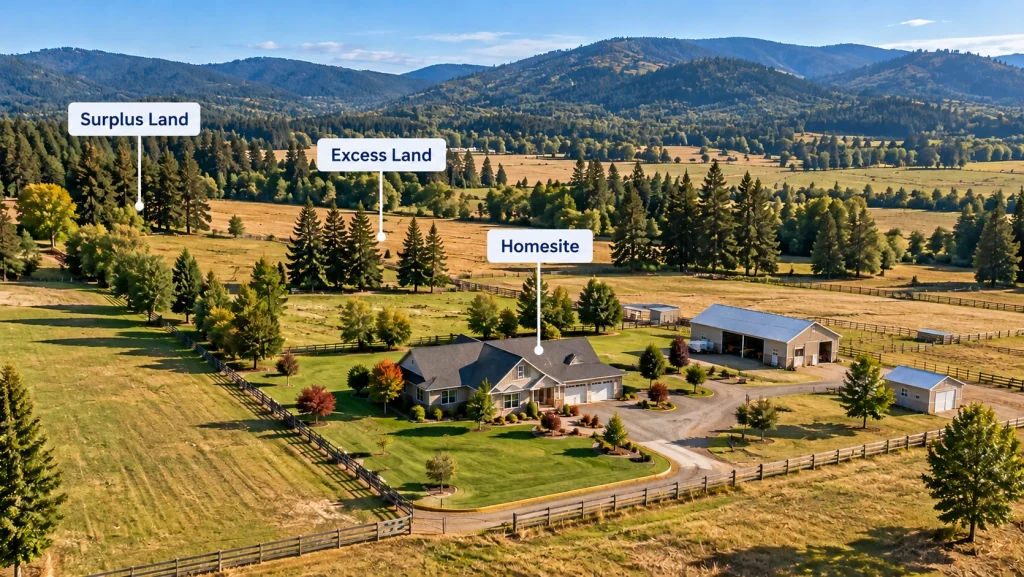
Excess land is acreage not needed to support the home that stands as a separate parcel, or is legally separable, with a highest and best use of its own; surplus land is acreage not needed to support the home that is not separable and carries no independent use. The Dictionary of Real Estate Appraisal, published by the Appraisal Institute, draws this line, and the line decides how the acreage is valued.
The two categories are treated in the appraisal as given below:
- Excess land is valued as its own parcel, from land sales, and added to the value of the homesite. A second buildable tax lot behind the home is excess land.
- Surplus land is valued as part of the whole property, from sales of homes on similar acreage. Thirty acres of steep timber behind a home on a single tax lot, with no right to divide, is surplus land.
The classification depends on legal lot status and zoning, not on acreage alone. The county assessor’s map and a legal lot determination from county planning settle it.
Why does the first acre carry more value than the fortieth?
The first acres carry the most value because the homesite depends on them, and each added acre contributes less as the parcel grows. Buyers pay a premium for the land that gives a rural home its setting and privacy. Beyond that point, buyers pay for use: pasture, timber, water, or a view.
A home on two acres in the Willamette Valley sells for more than the same home on a city lot. The same home on twenty acres sells for more again, but the jump per acre is smaller. On eighty acres, value rises only where the extra land earns income, holds timber or carries a second homesite right. Multiplying a per-acre figure across the whole parcel produces a value the market does not support.
How do zoning and farm-use designations change the land’s contribution?
Zoning and farm-use designations set the limits on new dwellings and land division, and the market prices those limits into the acreage. Oregon land zoned for exclusive farm use carries a minimum parcel size of 80 acres, or 160 acres on designated rangeland, under ORS 215.780, and counties adopt lower minimums only in defined cases. Forest zones carry an 80-acre minimum under the same statute.
The effect on value is direct. Forty acres of farm-zoned land with one home and no right to divide is surplus land, valued as part of the residence. Forty acres with an approved second homesite, or a legally separate tax lot, is excess land with its own value.
Farm and forest tax deferral lowers the tax bill and attaches use conditions a buyer inherits. The appraiser reads the deferral status from the county record for that reason.
How are outbuildings, wells and septic systems valued?
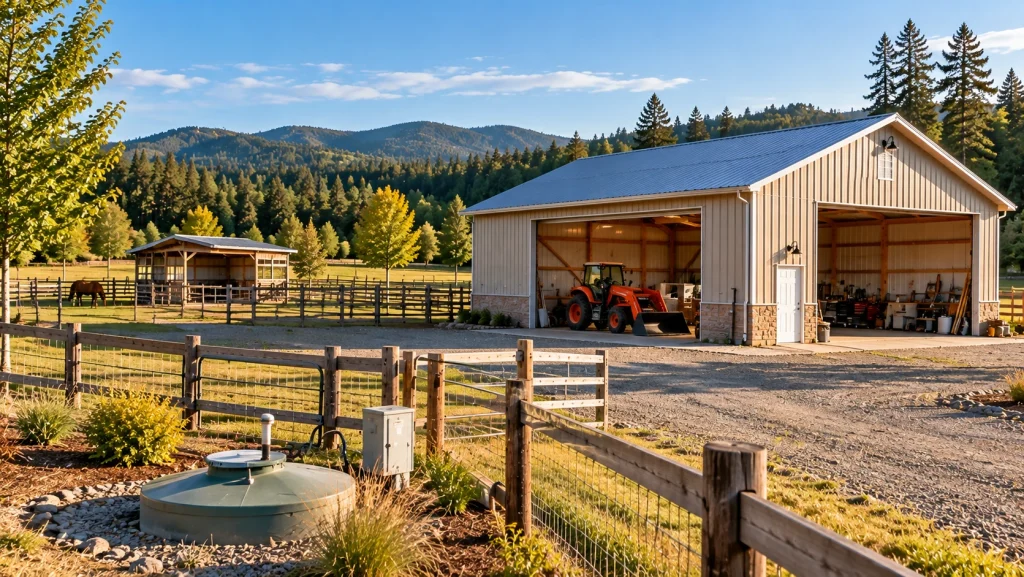
Outbuildings, wells and septic systems contribute what buyers in the local market pay for them, not what they cost to build or replace. A large shop adds value where buyers keep equipment and adds less where buyers want pasture alone.
The rules the appraisal applies to rural improvements are given below:
- Barns, shops and arenas are valued from paired sales of properties with and without them, adjusted for size, condition and utility.
- A private well and a septic system are typical in most rural markets and carry no premium on their own. A failed system or a well with low flow is a condition issue that lowers value.
- Water rights and fencing contribute where the land carries livestock or crops.
- Testing and certification of wells and septic systems belong to licensed inspectors. The appraiser records the condition observed and the documents provided.
What comparable sales does a rural appraisal rely on?
A rural appraisal relies on sales of homes on similar acreage, drawn from a wider geographic area and a longer time window than a city appraisal uses. Few rural properties sell in a year, and no two carry the same mix of land, improvements and water.
The search starts in the same market area, extends to adjoining rural markets with the same buyer pool, and extends the time window to two or three years with adjustments for market change. Each comparable is adjusted for acreage, zoning, outbuildings, water and condition.
Records of additions and outbuildings are often missing on long-held rural property, so the estate appraisal of long-held rural property depends on county permit history and dated aerial photographs. A later post explains how a retrospective value is developed when those records are missing. The purpose of the home appraisal decides which effective date the records must support.
What did a recent acreage assignment look like?
One recent assignment involved a manufactured home on approximately 120 acres with multiple wells, several legally separate tax lots and few comparable sales. I separated the residential site and its improvements from the additional acreage and valued each tax lot on its own size, utility and development potential.
I then valued the property as a whole, because a buyer for the entire holding pays a different price than buyers for the parts. The wells were recorded by location, since water sets the use of each lot. The report delivered a value for each tax lot and for the whole, which the family used for estate planning.
How do you order an acreage appraisal in Oregon or Washington?
Appraisal Services of Oregon appraises homes on acreage, rural residences and multi-tax-lot residential holdings across Oregon and Southwest Washington. Describe the property, the number of tax lots and the purpose of the appraisal on the request form or by phone at 503-757-7100. We confirm the scope and the effective date before the inspection.
What questions do rural owners ask about acreage and appraised value?
Does more land always mean a higher appraisal?
More land raises the appraised value only when the market pays for the added acreage. Surplus land on a single tax lot adds a small amount. Excess land with its own use adds its own parcel value.
Is farmland appraised with the house?
Farmland is appraised with the house when the parcel is one legal lot and the land supports the residence. Working farmland with income or commercial agricultural improvements is an agricultural appraisal, which our residential practice does not perform.
Who needs to be present at a rural property appraisal?
The owner or the owner’s representative is present to open outbuildings, locate wells and septic components, and point out property corners. The appraiser inspects the residence, the improvements and the land.
Why do rural appraisals take longer?
Rural appraisals take longer because the inspection covers more ground and the comparable sales search covers a wider area and a longer period. Our acreage and rural residential appraisal page describes the full scope.
Does a second tax lot change the value?
A second legal tax lot changes the value when the lot is buildable or separately marketable, because the lot becomes excess land with a value of its own. A lot with no access, water or dwelling right adds little beyond its acreage.